




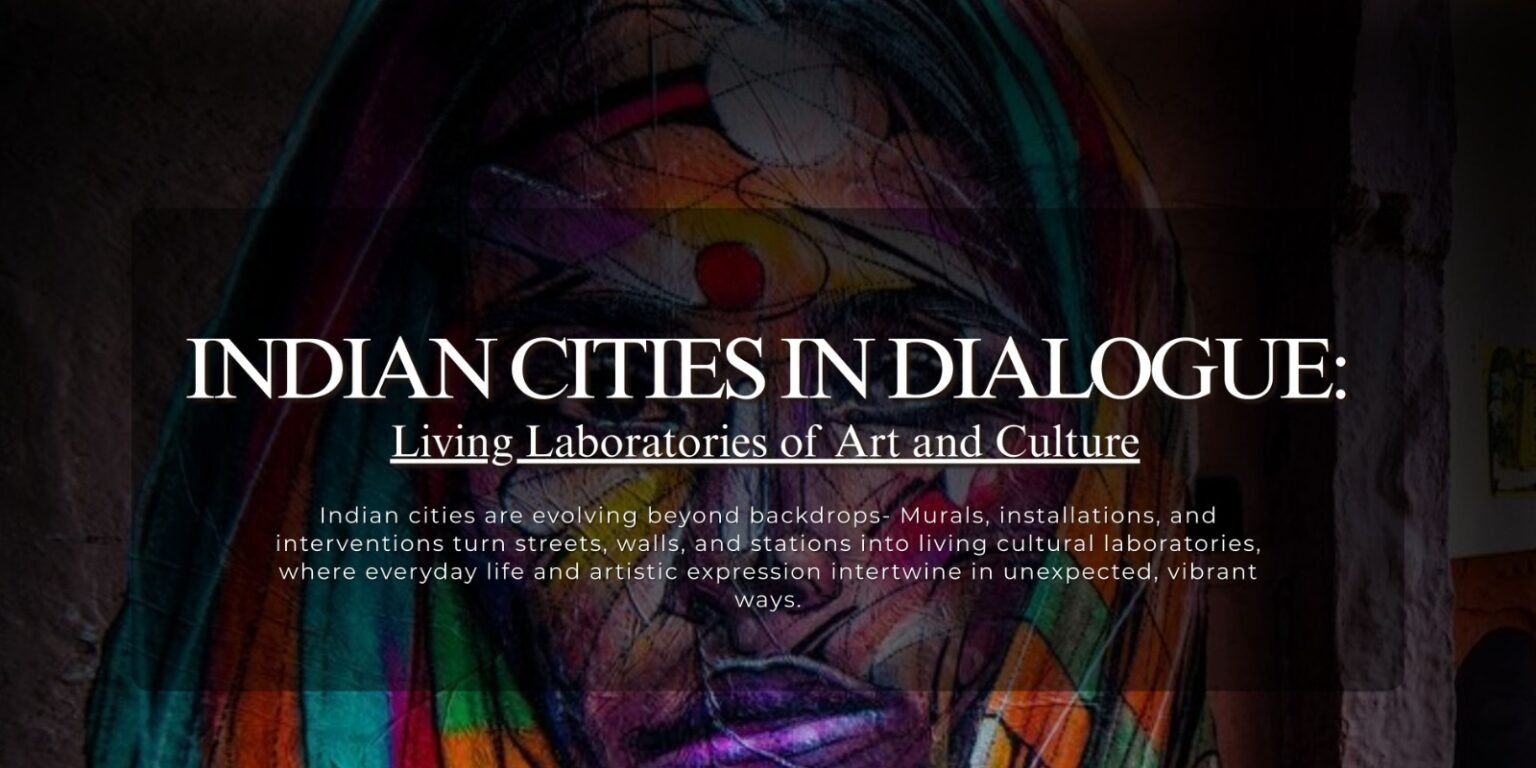

In the evolving cultural cartography of the 21st century, Indian urban centres are no longer mere backdrops to everyday life; they are palimpsests of meaning, creativity, and collective imagination. Across metropolises and secondary cities alike, walls, underpasses, stations, and precincts are being reconfigured as vibrant arenas for public arts. Here, murals, installations, and community interventions do not simply adorn civic surfaces; they animate them as living cultural laboratories where the city itself becomes both medium and message. By collapsing the binary between art and everyday urban experience, these interventions foster civic dialogue, identity formation, and collective engagement with issues ranging from memory and heritage to social equity and environmental awareness.
Public Art and Urban Activation
Traditionally, art was confined to gallery walls and institutional spaces, accessible primarily to self-selecting audiences. However, in recent decades, a global shift has occurred toward democratizing artistic experience by relocating it to everyday environments. In India, this shift is particularly visible in public art interventions that transform banal or neglected urban spaces into forums for collective reflection. This approach aligns with critical perspectives in urban theory that regard cities as dynamic sites of cultural production rather than static backdrops to institutional culture.
A paradigmatic example is the Lodhi Art District in New Delhi, acknowledged as India’s first official open-air public art precinct. Initiated between 2015 and 2016 through a project led by the Start India Foundation in collaboration with municipal bodies and cultural partners, the district has reimagined the walls of a residential neighbourhood as a vast canvas for large-scale murals by Indian and international artists. Rather than act as passive decorations, these works engage passersby in narratives of identity, environment, memory, and lived experience, generating conversations that ripple out across social spheres. Unlike gallery exhibits that presuppose a certain cultural literacy or socioeconomic privilege, public art in urban spaces invites unmediated encounter. A commuter, a street vendor, or a student walking home can stumble upon a mural depicting everyday life, a social message, or a cosmopolitan visual idiom. The city thus becomes a living archive of ideas, concerns, and collective aspirations, expanding cultural access while challenging norms about where and how art should exist.
Indian Cities As Testbeds for Collective Expression
India’s urban art scene has diversified rapidly in the past decade. In Hyderabad’s Maqtha Art District, for instance, large swathes of façades near Raj Bhavan and Hussain Sagar Lake have been reimagined through street art, creating a playful, colourful urban corridor that invites both residents and visitors into a dialogue with the city’s evolving identity. Similarly, stations like the Hubballi SSS railway platform in Karnataka are being activated through wall art tied to social campaigns such as Swachh Bharat Abhiyan, demonstrating how public art can support civic initiatives while imbuing functional spaces with cultural vitality.
These projects reflect a broader pedagogical shift in how art interacts with the urban sphere. They are not static installations that merely illustrate a curated theme; instead, they coalesce with daily rhythms and social behavior, turning streets into dynamic arenas of cultural expression. Such democratized visibility challenges hierarchies of taste and access, foregrounding art as a process that is shaped by community interaction rather than institutional inscription alone.
Art, Identity, and Collective Memory
Public murals and installations often serve as mnemonic devices, bridging collective memory and material space. A recent public art initiative in Varanasi’s Kabir Math illustrates this relationship: a large mural depicting the life and teachings of the medieval poet-mystic Kabir was commissioned to conserve and reinterpret cultural heritage within the contemporary public sphere. By integrating visual tribute with historic memory, such projects reinscribe cultural symbols within the contemporary cityscape, rendering heritage a part of everyday sensory experience rather than a relic of the past.
Across India, similar efforts have transformed streets into platforms where multiple histories converge, from local folklore and craft traditions to narratives of migration and belonging. The murals of Shekhawati in Rajasthan or the contemporary works in Fort Kochi (home to the Kochi-Muziris Biennale) further illustrate how walls and precincts can function as repositories of layered heritage and performative memory, accessible to all strata of urban life.
Collaborative Creation and Civic Agency
A distinguishing feature of contemporary public art in India is its collaborative orientation. Unlike top-down public commissions that risk imposing aesthetic forms on uninvolved communities, many mural districts and street art initiatives engage residents in meaningful ways. The St+art India Foundation, for example, actively involves local stakeholders in the creative process from conceptualization to execution, fostering a sense of collective ownership over urban spaces.

This participatory model underscores a broader democratic impulse in urban cultural practice. By inviting voices from diverse social geographies into the creation of public works, the process disrupts conventional narratives of artistic production, expanding agency well beyond professional artists to include neighbourhood residents, youth groups, and informal worker communities. The resulting artworks, therefore, are not just visual artefacts but embodied negotiations of meaning, shaped by the lived experiences and aspirations of those who encounter them daily.
Challenges and Future Trajectories
Despite its promise, the expansion of public art in Indian cities is not without challenges. Tensions often arise between regulatory bodies, community expectations, and artists’ creative autonomy. Securing sustainable funding, navigating bureaucratic processes, and ensuring the longevity of public works against environmental degradation remain pressing concerns. Yet these challenges also highlight a key insight: public art is inherently contingent on civic structures, and its success depends on the capacity of urban governance to cultivate partnerships that respect artistic integrity while addressing community needs.
Looking ahead, the future of Indian urban art lies in deepening these collaborative frameworks and in expanding discourse around tactical urbanism, a concept that emphasises lightweight, community-driven interventions as precursors to more permanent urban transformation. Such approaches not only enhance livability and accessibility but also foreground art as a tool for social inquiry, civic responsibility, and collective imagination.
Cities as Cultural Laboratories
When we speak of cities as living cultural laboratories, we acknowledge that urban space is not inert infrastructure but an active participant in civic life. Through murals, installations, and community art, Indian cities are asserting new modes of cultural expression, ones that valorize everyday experience over institutional exclusivity, and that valorize dialogue over passive consumption.
In this sense, public art does more than decorate the city; it reorients it, forging pathways for collective reflection and shared agency. By positioning art within the hum of daily life, these interventions encourage citizens not only to observe their surroundings but to question, connect, and imagine. Thus, the city itself becomes a canvas of possibility, an experiment in democracy, diversity, and cultural resonance.