





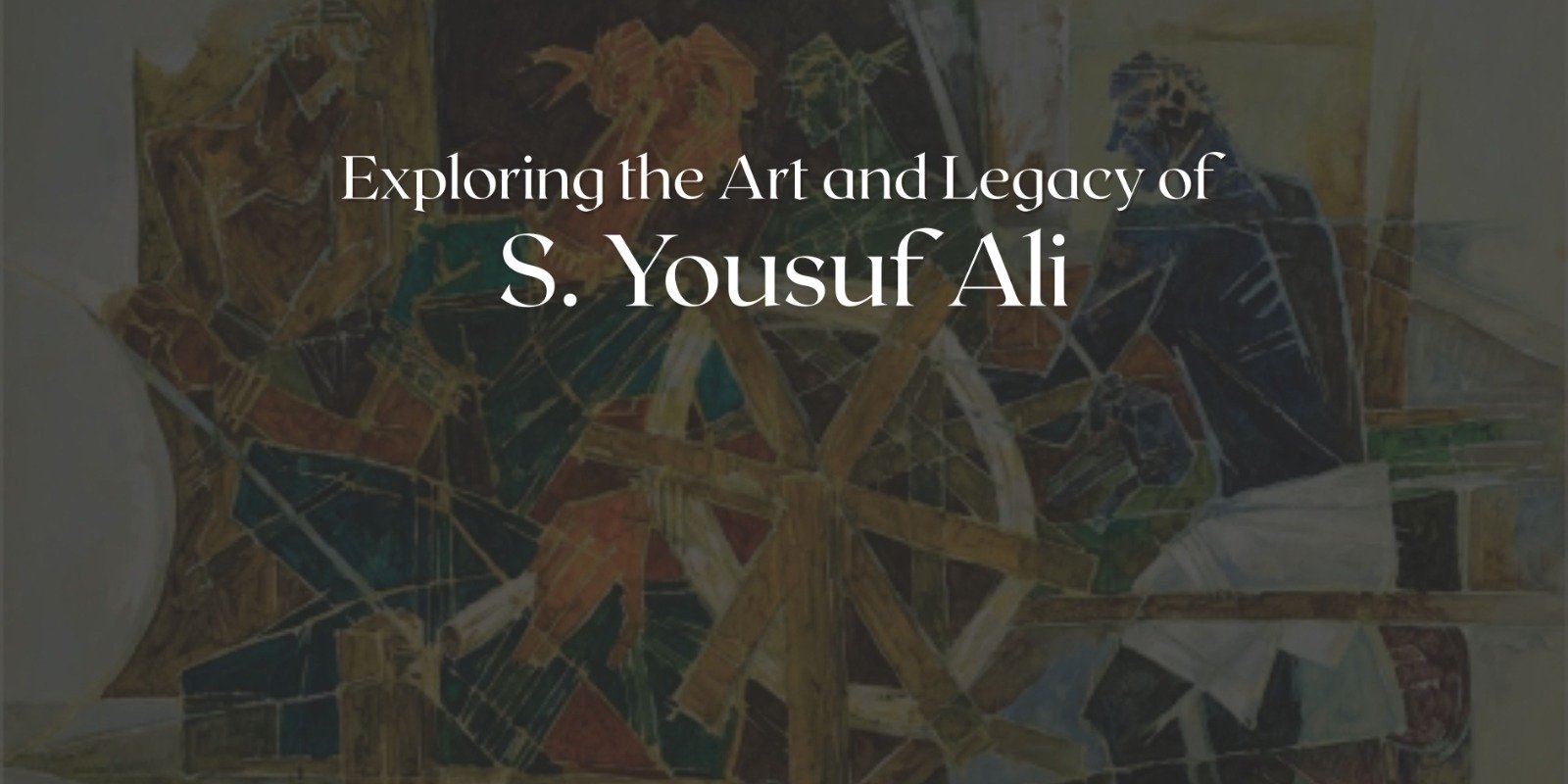
Modern Indian art holds certain figures who occupy an ambiguous space, widely admired in their lifetime yet insufficiently canonised afterwards. Among these is S. Yousuf Ali (1939–1997), a painter whose practice evolved at the intersection of anatomical precision, expressive abstraction, and cultural symbolism. Though his name may not sit alongside the most frequently cited Indian modernists, the vibrancy and earnestness of his artistic inquiry demand renewed attention and critical reassessment.
Born in Goa in 1939, Yousuf Ali’s early artistic formation was grounded in formal training at the eminent Sir J. J. School of Art, Mumbai, where he completed a Diploma in Painting in 1964. This foundational period equipped him with a fluency in figurative representation and compositional balance, typical skills he would later recalibrate into an idiosyncratic visual language that blended realism, cubist segmentation, and lyrical form.
Anatomy of a Style: Between Realism and Abstraction
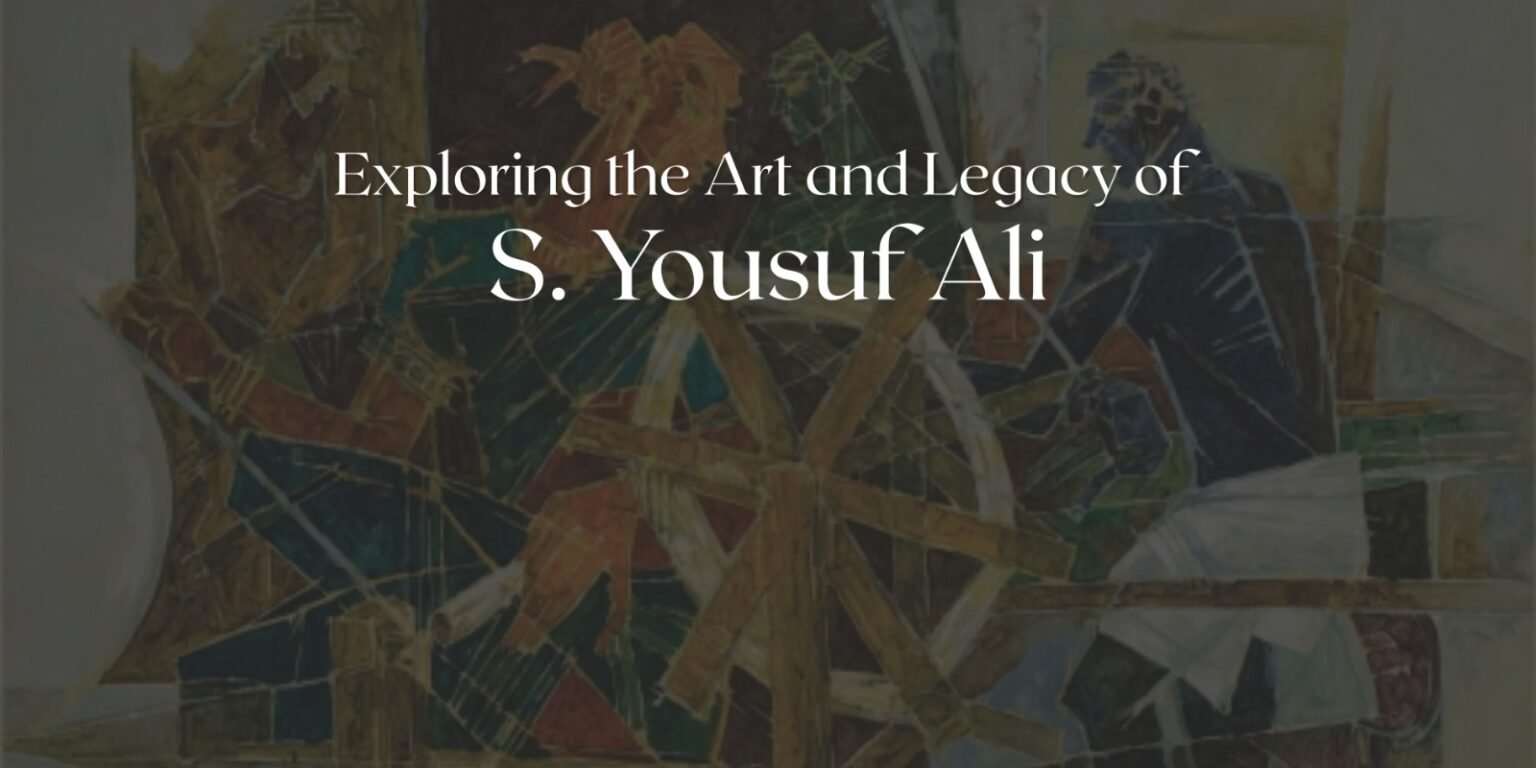
Yousuf Ali’s work resists facile categorisation. At first glance, his canvases present discernible figures, musicians, dancers, village folk, and religious icons, yet these subjects are rarely rendered in straightforward representational terms. Instead, he employed cubist segmentation, splintered spatial divisions, and expressive contouring to fragment and reassemble forms, guiding the viewer’s eye through a choreography of lines, planes, and colour interactions. His protagonists, frequently characterized by voluptuous shapes and exaggerated anatomical emphasis, convey both presence and movement, revealing an artist deeply attuned to the expressive potential of human form.
Perhaps most striking is the way Yousuf balances formal structure with emotive immediacy. Rather than dissolving into abstraction alone, his figures maintain a visceral resonance; hands, faces, and bodily gestures are orchestrated not merely as compositional elements but as expressive vectors that table human experience in all its complexity. In this sense, his art negotiates a compelling middle ground: neither anchored solely in realism nor indulging in pure formal experiment, instead, it invites contemplation of form as an emotive and symbolic bearer of meaning.
Themes and Motifs: From Music to Myth
Yousuf’s chosen themes reflect a remarkable breadth of interest. Early in his career, he depicted musicians and performers, infusing his compositions with rhythmic undulations that mirror the auditory experience of music. His interest in Indian classical performance, such as dancers with articulate gestures and poised forms, underscores a preoccupation not just with representation but with the dynamics of cultural expression.
Another persistent motif in his work is the figure of Ganesha, treated not merely as a religious symbol but as a plastic form open to visual interpretation. Yousuf saw in the elephant-headed deity’s contours a generative template for exploring shape, volume, and narrative ambiguity. Here, Ganesha functions both as a culturally resonant subject and as an aesthetic challenge a vehicle through which the artist negotiates tradition and innovation. Such thematic versatility points to a practice grounded in cultural plurality, where spiritual motifs and quotidian scenes coexist in dynamically composed pictorial fields.
In a fascinating extension of his thematic range, Yousuf also produced a series of Allah calligraphy paintings, deriving inspiration from Islamic calligraphic traditions and Persian typographical forms. These works, abstract in visual comportment yet grounded in devotional reverence, underscore his sensitivity to cultural symbolism and suggest an artist deeply attuned to the visual poetics of belief systems beyond literal representation.
Technique and Materiality
A significant dimension of Yousuf Ali’s legacy lies in his remarkable command over diverse media. Across oil, watercolour, ink, and mixed techniques, he demonstrates an uncanny ability to manipulate material surfaces with precision and expressive force. His ink works, in particular, reflect a nuanced control of fluidity and line, a technical virtuosity that enabled him to articulate complex spatial rhythms without sacrificing clarity or impact.
Moreover, critics and contemporaries describe his process as deeply intuitive, with brush and pen responding to an internalized visual impulse rather than rigid preplanning. This spontaneous engagement with material and form, akin to a visual improvisation, situates his work within a lineage of artists who privilege embodied creation over mechanical execution.
Reputation, Reception, and Market Presence
During his lifetime, Yousuf Ali exhibited extensively, holding more than eleven solo shows in India and abroad, including notable exhibitions at The Taj Art Gallery in Mumbai and venues in the United Arab Emirates. These exhibitions were met with critical appreciation and commercial success, allowing him to transition from a career in advertising to full-time artistic practice.
Contemporary auction records indicate a sustained market interest in his works. According to MutualArt, his paintings have been offered at auction multiple times, with prices ranging from approximately USD 1,171 to USD 16,910, the latter achieved for a work titled Lust for Life at Saffronart Mumbai in 2025. Such figures underscore a posthumous recognition that situates Yousuf Ali within the broader circuits of Indian modern and contemporary art collecting.
Yet despite this market presence, Yousuf’s critical legacy remains unevenly documented in mainstream art historical discourse. Scholars and collectors alike have remarked on the need for more substantial archival and critical attention, as his works reveal complex aesthetic logics and cultural resonances deserving of broader scholarly engagement.
Legacy and Contemporary Relevance
Yousuf Ali’s corpus occupies an intriguing intersection: firmly rooted in Indian cultural idioms, yet situated within a hybrid modernism that embraces both figuration and abstraction. In an era of art that increasingly foregrounds hybridity, narrative multiplicity, and formal innovation, his works resonate with contemporary artistic preoccupations, even as they challenge reductive category labels.
The continued interest in his paintings, both in private collections and at auction, suggests that his art has enduring appeal. More importantly, the thematic depth and material ingenuity of his practice invite fresh critical dialogue about the plurality of modern Indian art, especially forms that exist outside dominant canonical narratives. Yousuf Ali’s art, in this view, is not merely a historical artefact but a living constellation of forms and meanings that continues to inform how we think about figuration, form, and cultural expression in modern painting.