





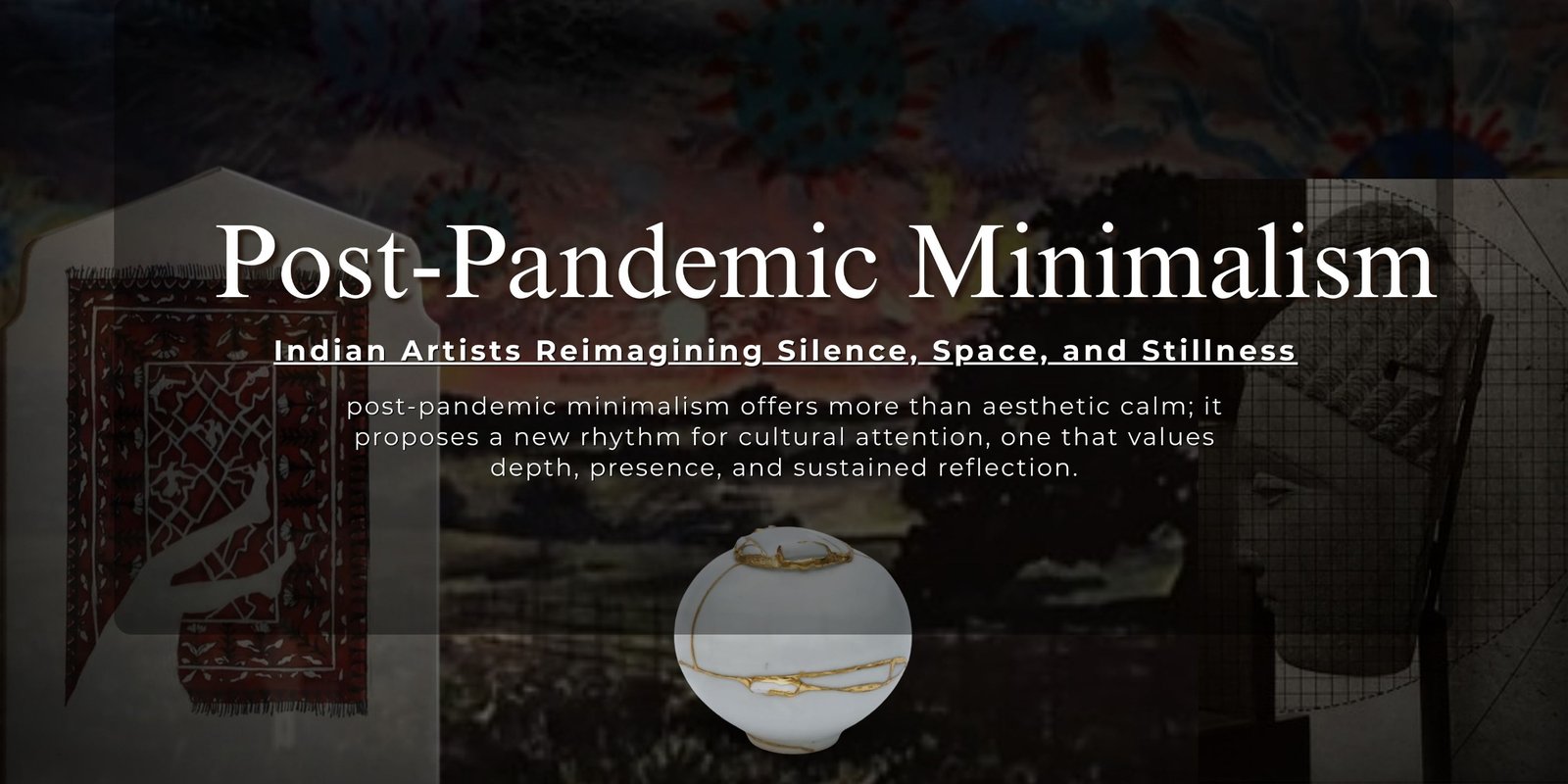
The global COVID-19 pandemic not only reshaped social and economic life but also reframed artistic sensibilities. In the wake of prolonged lockdowns, enforced solitude, and collective introspection, many artists and institutions began to reappraise the meaning of space, silence, and stillness not as mere formal concerns but as profound aesthetic and philosophical imperatives. With everyday life disrupted by isolation and uncertainty, creative practice gravitated toward what might be called post-pandemic minimalism: an artistic approach that foregrounds quietude, negative space, and attentiveness as antidotes to a world previously defined by acceleration and sensory overload.
At its core, minimalism has long privileged reduction, not as absence, but as presence through restraint. As art historians note, silence in art is not a void, but a zone of contemplation where meaning emerges within absence rather than through accumulation of form. When pared down to essentials, visual language can redirect attention to the embodied experience of viewing itself, to the thresholds of perception where cognition and emotion converge.
Silence, Stillness, and the Art of Presence
In contemporary practice, artists are making stillness palpable in ways that resonate with the psychological resonance of the pandemic. Silence, in this sense, becomes an active force: a space where distraction dissolves and deeper engagement with material and concept becomes possible. This echoes earlier minimalist and post-minimalist legacies, where artists like Agnes Martin used subtle grids and muted surfaces to cultivate contemplative environments, urging viewers to surrender familiar modes of looking and instead encounter being.
Similarly, Japanese artist Rei Naito’s work exemplifies this philosophical evolution. Naito’s installations, such as the acclaimed Being Given, do not assert themselves as objects, but instead allow space itself to become the artwork, inviting viewers into an experience of silent presence. In these works, nothing overtly happens, yet the sensation of being present becomes profound. Her practice embodies the idea that minimalism is not an aesthetic of emptiness, but an invitation to attend to the fullness inherent in absence.
These sensibilities have gained fresh urgency in the post-pandemic context. Isolation and confinement made palpable the ways interior and exterior spaces shape psychological states. Artists responding to this shift have increasingly emphasized negative space, not only as a compositional strategy but as a conceptual vehicle to explore temporality, memory, and solitude. Here, silence becomes a structural and emotional element: a counterpoint to digital noise and the fragmentation of attention that characterized much of the pandemic experience.
Spatiality as Emotional Geography
Contemporary approaches to space also reflect a deeper engagement with how environments mediate emotional life. Installation and architectural art are now informed by a post-pandemic understanding of how built space affects psychological boundaries. Dutch artist Marleen Sleeuwits, for example, transforms ordinary architectural elements into immersive environments where scale, perspective, and perceptual expectation are unsettled. Such work emphasizes the skin of environments, the subtle atmospheric qualities that shape our awareness of being in and among spaces.
Elsewhere, the formal discipline of minimalism has been reinterpreted in series like those of Tavar Zawacki, who, in his Papel works, uses reductive geometric forms and folded surfaces to explore tension and balance, notions deeply resonant with post-pandemic experiences of containment, rupture, and the longing for connection.
Minimalism Beyond Aesthetics: Silence as Resistance
The resurgence of minimal and still artistic vocabularies post-COVID is not simply stylistic. It represents an implicit critique of a culture addicted to speed, novelty, and information saturation. Contemporary voices argue that silence and stillness in art enact a form of resistance; they slow down perception, invite reflection, and reclaim attention as a precious resource. These attributes make quiet art not passive, but deliberately subversive, challenging the viewer to rethink engagement itself.


This shift also intersects with emerging theoretical frameworks like decolonial minimalism, which reframes reductive aesthetics as a means of reclaiming space, memory, and indigenous identity within global artistic discourse, compressing history and cultural presence into restrained yet layered expression
Looking Forward: The Art of Attentiveness
As we move further into the post-pandemic era, minimalism’s revival highlights an enduring truth: that art’s capacity to slow us down is not a regression, but a reorientation. Silence, space, and stillness no longer function merely as aesthetic strategies, but as modes of emotional and conceptual inquiry. In foregrounding quietude, contemporary artists are not retreating from complexity, but reframing the conditions under which complexity becomes visible.
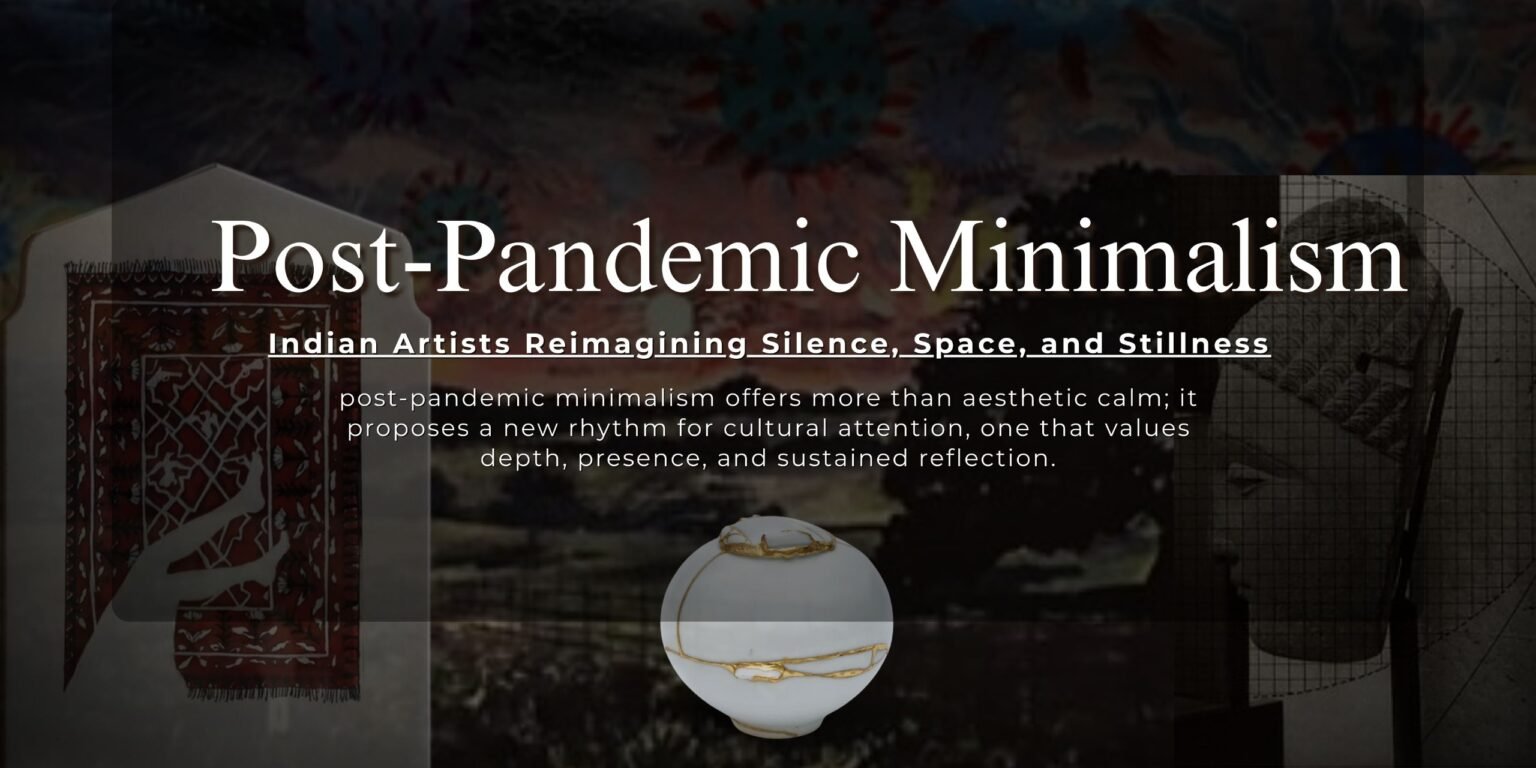
In this sense, post-pandemic minimalism offers more than aesthetic calm; it proposes a new rhythm for cultural attention, one that values depth, presence, and sustained reflection. For audiences exhausted by noise and flux, it invites a reconsideration of how we engage with art, not as a spectacle to be consumed, but as an encounter to be felt.