
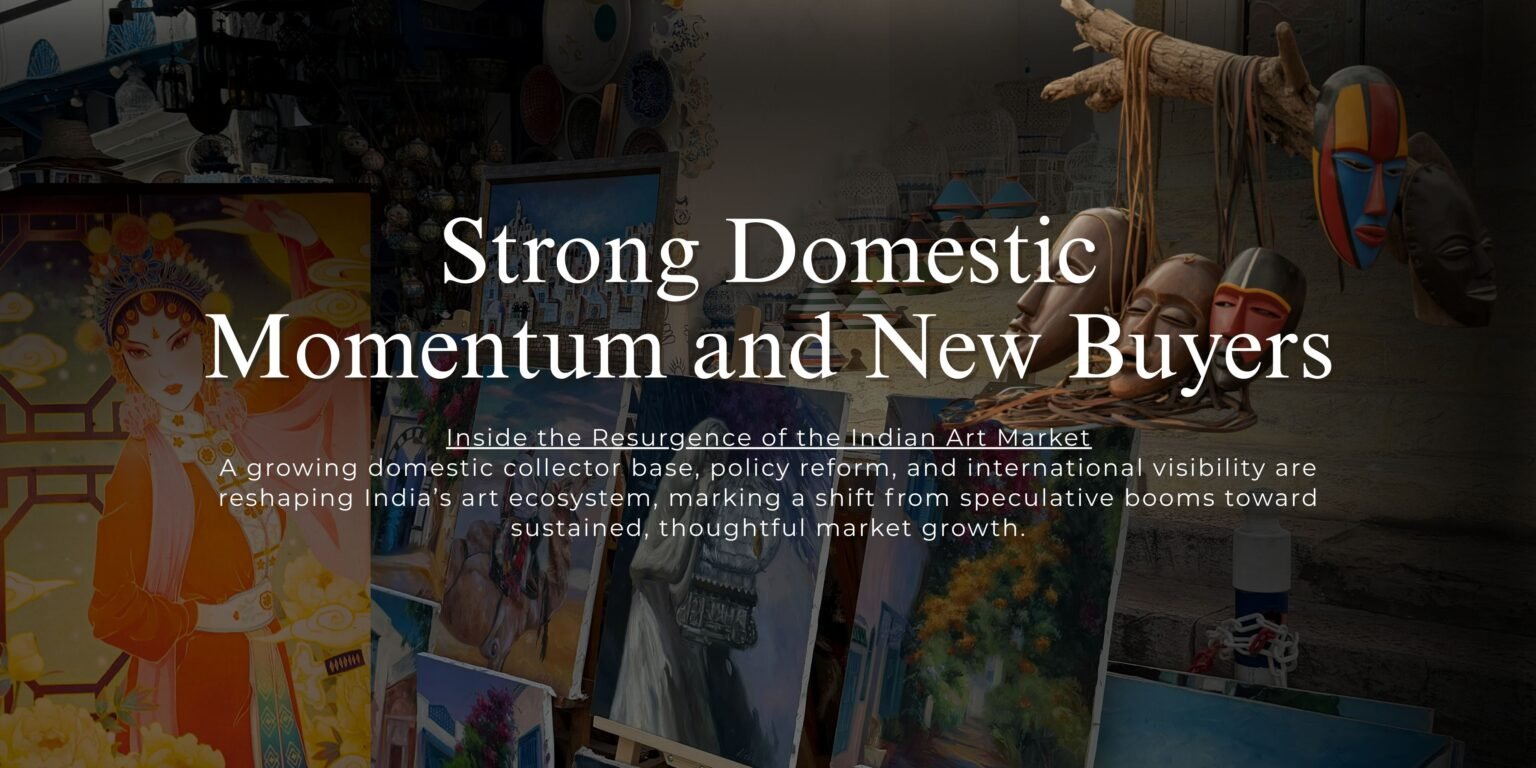

The Indian art market is undergoing a significant and sustained transformation. Once perceived as volatile or narrowly elite, it has evolved into a more resilient and diversified ecosystem over the past decade. Recent developments, ranging from fiscal policy changes to the emergence of younger collectors, suggest that the present moment is not merely cyclical growth, but a structural recalibration of how art is produced, circulated, and valued in India.
From Speculation to Sustainability
The early 2000s marked a speculative high point for Indian art, driven largely by rapid buying and selling rather than long-term collecting. That phase ended abruptly with the global financial crisis of 2008, exposing the fragility of a market dependent on quick returns. Since then, however, the Indian art ecosystem has gradually rebuilt itself, guided less by speculation and more by sustained domestic engagement.
Today’s growth is anchored in a broadened base of collectors, galleries, and institutions. Rather than relying primarily on international buyers, the market is increasingly supported by Indian patrons who view art as both cultural capital and long-term commitment. This shift has produced greater stability and a more measured, informed approach to collecting.
The Impact of Policy and Tax Reform
A key catalyst in the market’s recent momentum has been fiscal reform. The reduction of Goods and Services Tax (GST) on artworks, from 12 percent to 5 percent, has had an immediate and tangible effect on purchasing behavior. Lower transaction costs have made art more accessible, encouraging hesitant buyers to enter the market and enabling collectors to expand their acquisitions.
This policy change signals a rare instance of state-level support for the visual arts in India, where cultural infrastructure has historically been driven by private initiative. While public museums and acquisitions remain limited, tax incentives represent a meaningful step toward legitimizing art as a sector worthy of institutional encouragement.
A New Generation of Collectors
One of the most notable shifts in the current market is the emergence of younger collectors, typically in their late thirties and forties. Many of these individuals are first-time buyers who encounter art through architecture, interior design, and lifestyle media rather than traditional art historical pathways.
The pandemic played an unexpected role in accelerating this trend. Prolonged time spent at home led many to reconsider their domestic environments, prompting an interest in art not only as decoration but as a source of identity and intellectual engagement. For this new generation, collecting art often begins as an aesthetic choice and gradually evolves into a deeper cultural pursuit.
Importantly, these collectors tend to be well-informed and discerning. Rather than seeking only established names, they are increasingly attentive to narrative, medium, and personal resonance. Collections today are less about brand recognition and more about individuality, often encompassing photography, sculpture, installation, and even video alongside painting.


Galleries, Fairs, and Global Visibility
Indian galleries have played a decisive role in shaping this maturing market. By participating in international art fairs, staging overseas pop-up exhibitions, and supporting institutional collaborations, they have expanded the global visibility of Indian artists while simultaneously strengthening the domestic collector base.
Art fairs such as the India Art Fair have become central platforms for dialogue between artists, collectors, curators, and the public. Beyond sales, these events foster education, exposure, and critical exchange, helping to situate Indian art within broader global conversations.
At the same time, Indian modern and contemporary works are achieving record prices at auctions, attracting both domestic buyers and members of the Indian diaspora. This dual presence, local commitment paired with international recognition, has reinforced confidence in the market’s long-term potential.
Private Initiative and the Question of Infrastructure
Despite this optimism, challenges remain. India’s art ecosystem continues to rely heavily on private galleries, collectors, and foundations. Public museums play a limited role in acquisitions and exhibition programming, and state-supported cultural infrastructure remains underdeveloped compared to global counterparts.
Nevertheless, privately led institutions, biennales, and foundations have filled critical gaps, fostering research, education, and access. Their efforts suggest that while state involvement is desirable, the market’s current vitality rests on entrepreneurial vision and sustained community engagement.
Looking Ahead
The present strength of the Indian art market lies not merely in rising prices or increased visibility, but in its evolving ethos. Collecting is becoming more thoughtful, institutions are more ambitious, and audiences are more engaged. The convergence of policy support, generational change, and global dialogue has positioned Indian art within a more confident and self-sustaining framework.
As India’s cultural economy continues to expand, the art market stands as a compelling indicator of broader shifts toward patience over speculation, depth over speed, and cultural investment over short-term gain. What is unfolding now is not a fleeting boom, but the steady articulation of a more mature and globally resonant art ecosystem