




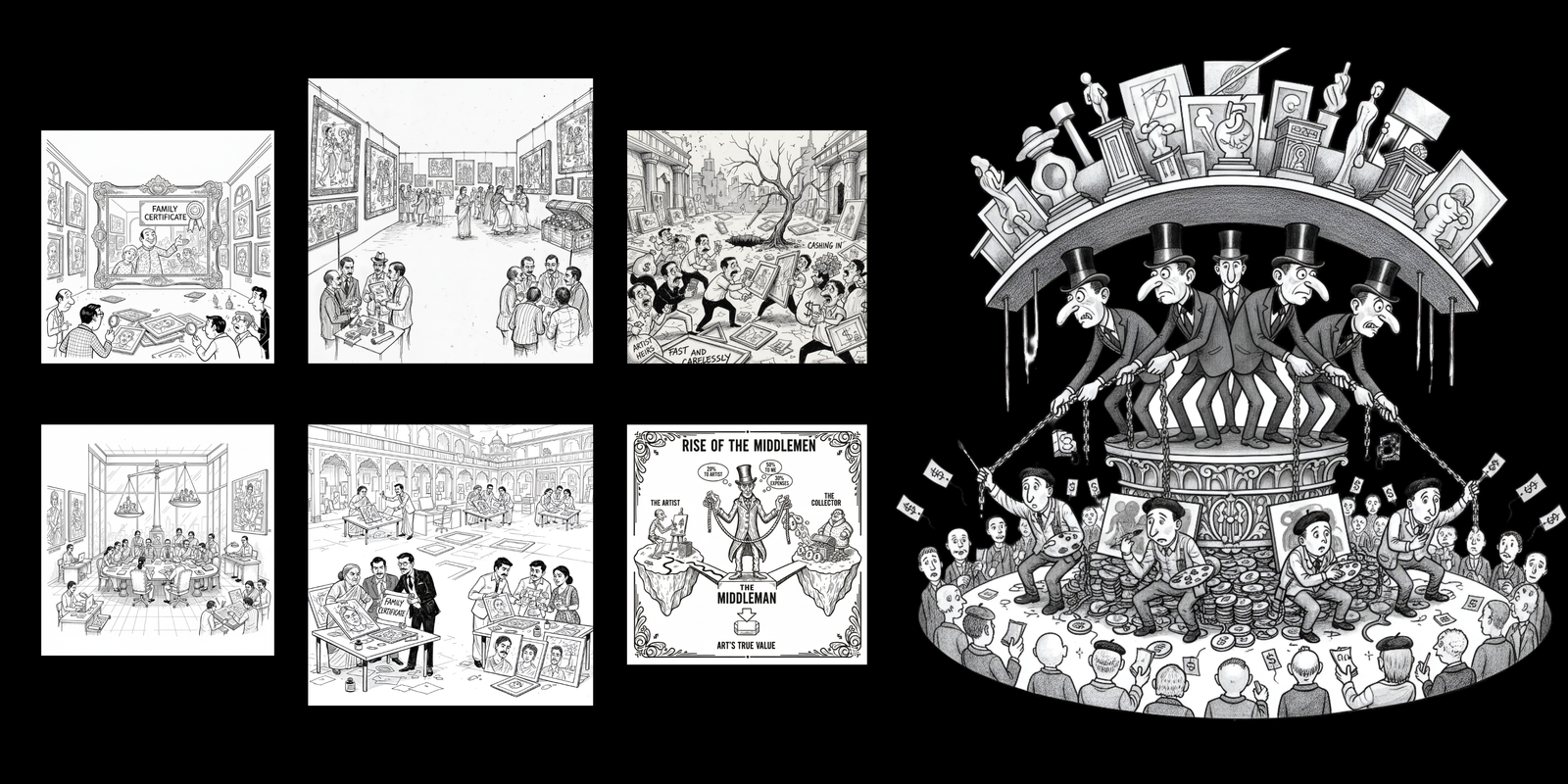

In recent years, a troubling pattern has emerged within the Indian art ecosystem: the children and heirs of several significant modern and contemporary artists are increasingly cashing in on their parents’ names, often in partnership with dubious businessmen, dealers, and backroom operators. What should have been a stewardship of cultural heritage has devolved, in many cases, into a commercial free-for-all—one that threatens to distort the market, confuse collectors, and permanently damage the legacies of important Indian artists.
Many of India’s post-independence masters worked in humble circumstances, without imagining the scale of today’s market. Their children and families, suddenly confronted with the enormous monetary value of these estates, lack the training, sensitivity, or even the intent to preserve an artist’s oeuvre with integrity. Instead, many heirs have become willing participants in rapid monetisation schemes—releasing questionable works, providing “family certificates,” or partnering with local fixers who promise quick cash in exchange for access to the artist’s name.
This shift has created fertile ground for shady businessmen, small-time dealers, and art market opportunists. These actors exploit heirs who are either financially vulnerable, naïve, or willingly complicit. The result is a dangerous ecosystem where undocumented studio remnants, half-finished canvases, unused paper sheets, and even old signatures are exploited to create market-ready “newly discovered works.” Without rigorous archival discipline, many families become conduits for works of dubious authenticity entering circulation.
Collectors bear the brunt of this chaos. A single whispered endorsement from a family member—often someone who never meaningfully engaged with the artist’s practice—is treated as gospel. Unscrupulous dealers use these endorsements to inflate prices, move questionable works, and legitimise pieces that would otherwise be rejected. In the process, genuine works get overshadowed by a sea of inconsistencies, making it harder for serious collectors to trust or invest.
Even worse, the artists themselves suffer posthumously. Their stylistic evolution becomes muddied. Their catalogues raisonnés, if they exist at all, become compromised. Public institutions grow wary of acquiring works. The long-term scholarship around these artists—their techniques, phases, materials—gets clouded by market noise generated through greed and short-term profiteering.
The tragedy is that India lacks strong institutional mechanisms to counter this. Unlike the West, where artist estates are often run as professionally managed foundations with archivists, scholars, and legal oversight, Indian estates are largely informal, personality driven, and vulnerable to manipulation. As a result, the gatekeepers of legacy are often the least equipped to shoulder that responsibility.
If this trend continues, the art market risks becoming a playground for forgery, manipulation, and manufactured provenance. The need of the hour is transparency: families must collaborate with independent scholars, galleries must prioritise due diligence over profit, and the art community must collectively push for professional estate management frameworks.
Indian art history is too important to be left at the mercy of untrained heirs and opportunistic middlemen. Preserving legacy is not just about protecting value—it is about safeguarding cultural heritage for generations to come. If we fail to act now, the damage will be irreversible.