






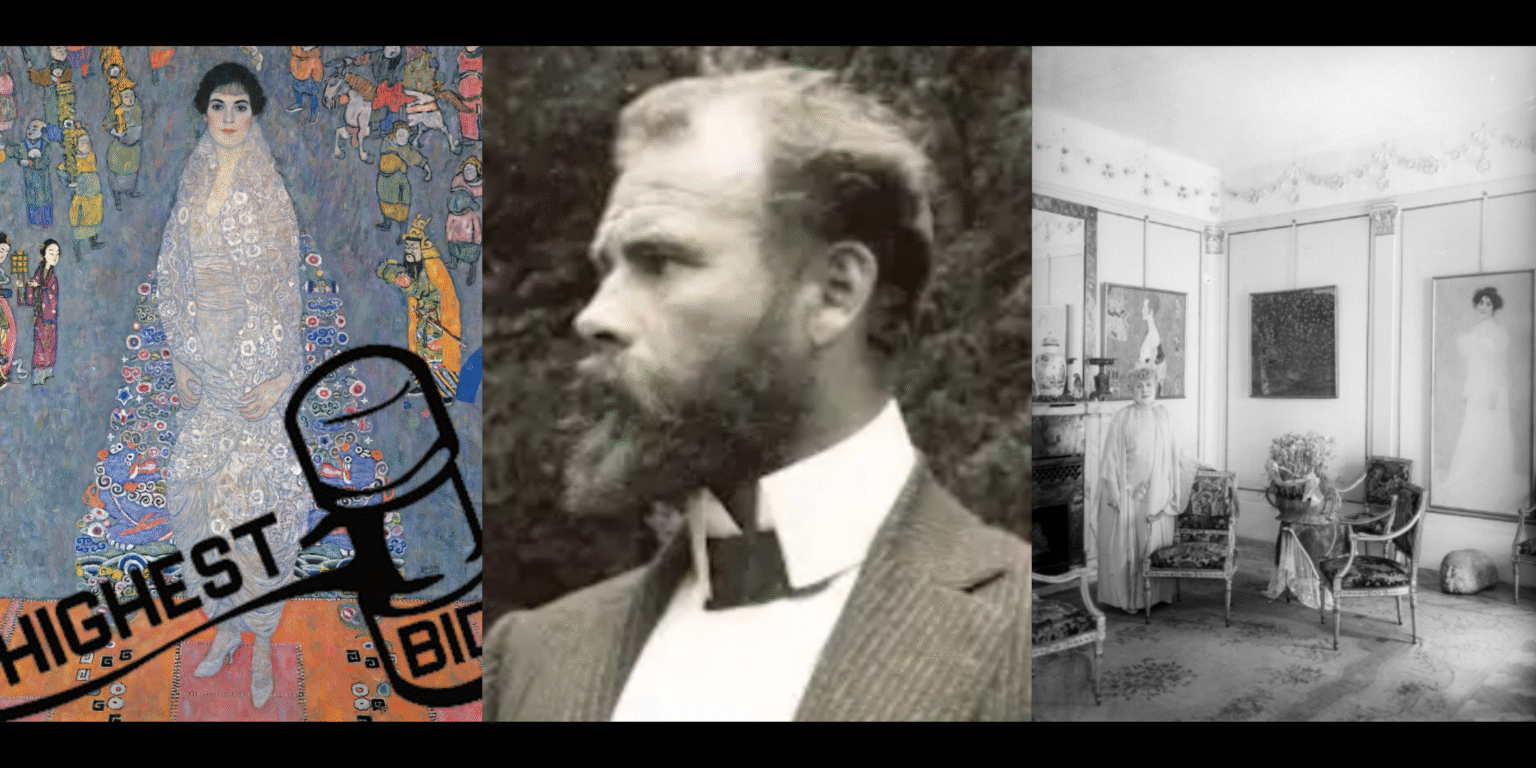

In a landmark moment for the global art market, a rare full-length portrait by Gustav Klimt has sold for an astonishing $236 million, breaking the modern art auction record and securing its place among the most valuable artworks ever sold. The painting, Portrait of Elisabeth Lederer, achieved the extraordinary result at Sotheby’s in New York, following a breathtaking 20-minute bidding battle that captivated collectors, dealers, and museums worldwide.
This sale not only reaffirms Klimt’s enduring power in the market but also brings renewed attention to a painting that survived war, fire, and Nazi persecution — a work whose history is as dramatic as its final price.
A Masterpiece with a Story of Survival
Painted between 1914 and 1916, the six-foot-tall portrait shows Elisabeth Lederer, daughter of one of Vienna’s wealthiest families, adorned in an opulent East Asian emperor’s cloak. The artistic grandeur alone makes it one of Klimt’s most striking works, but its survival story elevates it further into art-historical legend.
Most of Klimt’s works were tragically destroyed or lost during World War II, including several paintings that were burned in a fire at an Austrian castle. Portrait of Elisabeth Lederer survived only because it was kept separate from the other Klimt canvases at the time of the blaze. This rare stroke of luck preserved one of the last remaining full-length Klimt portraits still in private hands — only two exist outside institutional collections.
Its survival is inseparable from Elisabeth Lederer’s own story. As a Jewish woman living through the rise of Nazi power, she used the painting in a strategic and desperate effort to stay alive. According to historical accounts, Elisabeth crafted a story asserting that Klimt — who was not Jewish and died in 1918 — was her father. Because the artist had spent years working meticulously on her portrait, the narrative seemed plausible enough to convince Nazi officials. With the help of her former brother-in-law, a high-ranking Nazi officer, she secured documents declaring Klimt as her father. This ruse enabled her to remain in Vienna until she died of illness in 1944.
The painting, in many ways, represents both artistic beauty and human survival.
A Family Caught in Turbulent History
The Lederer family was among Klimt’s most important patrons. Their art collection included several of his major works, many of which were stolen when Nazi Germany annexed Austria in 1938. Ironically — and tragically — the portraits of family members were not looted. According to the National Gallery of Canada, they were considered “too Jewish” to be worth stealing. These pieces became some of the few surviving works tied to a family whose cultural legacy was nearly erased.
After the war, Portrait of Elisabeth Lederer was returned in 1948 to her brother, Erich Lederer, himself a friend of Egon Schiele, Klimt’s famed contemporary. The painting stayed with Erich for most of his life until he sold it in 1983. From there, it entered the private collection of Leonard A. Lauder, the billionaire Estée Lauder heir, who acquired it in 1985 and displayed it in his Fifth Avenue home.



This exceptionally strong provenance — Klimt → Lederer family → Lauder collection — added tremendous weight to its cultural and market value.
The Auction That Made History
Sotheby’s entered the sale predicting a strong result, estimating the portrait would fetch around $150 million. But the intensity of the bidding far exceeded expectations. Six bidders participated, driving the price up in steady, tense increments until reaching an unprecedented $236 million.
Sotheby’s did not disclose the identity of the buyer, a common practice for purchases of this magnitude. Regardless of who now owns the work, the sale eclipses previous benchmarks, including the former modern art record of $195 million for Andy Warhol’s Shot Sage Blue Marilyn (2022). It also becomes the second-most expensive artwork ever sold at auction, trailing only Salvator Mundi, attributed to Leonardo da Vinci, which reached $450.3 million in 2017.
The sale also surpassed Klimt’s previous record, the 2023 London auction of Lady with a Fan for $108.8 million.
Why This Klimt Matters: Rarity, Beauty, and Cultural Legacy
- One of the Last Full-Length Klimt Portraits in Private Hands
Klimt produced only a handful of full-length female portraits, and most are held in museums. The rarity of this format alone dramatically heightens the painting’s value.
- A Window into Vienna’s Golden Age
The portrait captures the opulence and social world of pre-war Vienna — a period often called the Viennese Golden Age — through its lavish costume and patterned background.
- A Story of War, Loss, and Survival
Its connection to Nazi looting and the survival of both artwork and subject adds layers of historical weight unmatched by most modern artworks.
- Prestigious Provenance
Its journey from the Lederers to Leonard A. Lauder provides impeccable pedigree — a key factor in high-value auction results.
- Klimt’s Enduring Influence
Known for masterpieces like The Kiss, Klimt remains one of the most beloved artists of the early 20th century. His blend of Symbolism, decorative motifs, and psychological depth resonates with both scholars and contemporary collectors.
The Lauder Collection and Its Impact
The sale was part of an auction featuring several Klimt works from the Leonard A. Lauder collection, following Lauder’s passing earlier this year. Other major Klimt pieces, such as Flowering Meadow and Forest Slope at Unterach am Attersee, fetched between $60 million and $80 million, underscoring the exceptional strength of the Klimt market.
The presence of multiple Klimts in one sale amplified global attention, but Portrait of Elisabeth Lederer unquestionably stood as the jewel of the collection.
A Market Moving Upward
Klimt’s market has experienced steady growth over the past decade, driven by international collectors, museum interest, and increased recognition of early modernist masters. This sale signals strong confidence in blue-chip 20th-century works — particularly those with impeccable provenance and rarity.
The fact that the portrait soared nearly $86 million beyond its estimate demonstrates that demand for top-tier art remains robust, even in uncertain economic climates.
Meanwhile, the same auction evening saw a fully functioning gold toilet sculpture by Maurizio Cattelan sell for $12.1 million — a reminder of the eclectic and unpredictable nature of contemporary sales.
A Defining Moment in Art History
The $236 million sale of Portrait of Elisabeth Lederer marks more than a market milestone. It represents the preservation of cultural memory, the resilience of art in times of destruction, and the continued fascination with Gustav Klimt’s visionary work.
With its unprecedented price, dramatic backstory, and artistic significance, the painting stands as a testament to the power of art to endure — and to captivate generations long after its creation.